
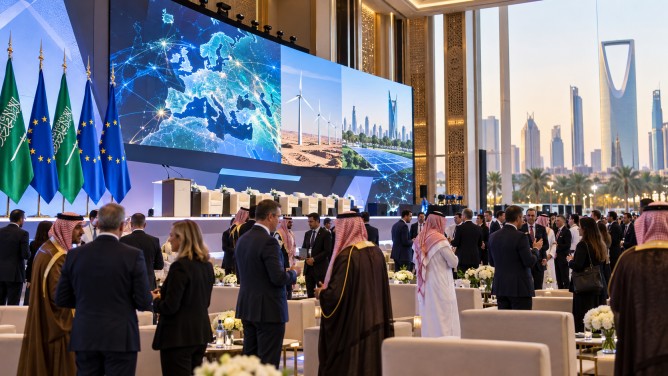
The EU-Gulf Cooperation Council (GCC) Summit, set to take place on October 24 in Riyadh, is poised to emphasize investment in emerging sectors such as artificial intelligence, digital infrastructure, and clean energy. This marks a strategic move towards forging a comprehensive economic partnership that extends beyond the traditional trade dynamics that have previously characterized relations between the two regions.
With goods trade between the European Union and GCC states reaching €165.7 billion in 2025, both regions are now focusing on long-term investment opportunities. The summit is expected to explore potential collaboration in artificial intelligence, including investments in data centers, cloud computing, and cybersecurity. The combination of the Gulf’s substantial investment capacity and Europe’s expertise in research and technology could pave the way for significant advancements in the AI sector.
Another focal point will be digital connectivity, with discussions likely to delve into enhancing telecommunications networks, data infrastructure, and cybersecurity measures. This approach could lead to an evolution of the economic ties between the EU and GCC, extending beyond conventional transport and trade links.
Clean energy remains a priority area, with the summit expected to explore investments in solar and wind power, green hydrogen, and smart grid technologies. Europe’s need for large-scale energy investments could create avenues for Gulf investors to collaborate with European technology firms on projects within the region and globally.
The discussions are anticipated to touch on advanced manufacturing, logistics, fintech, healthcare technology, and industrial equipment, aiming to create integrated value chains across the regions. However, no specific joint AI or technology investment projects have been announced yet; the summit’s focus is expected to be on transforming these broader economic priorities into practical partnerships.
A significant economic issue on the agenda is the EU-GCC free trade agreement, with the European Union seeking improved market access and clearer trade and investment rules. Consultations with businesses and investors are ongoing to assess the agreement’s potential economic impact.
For Saudi Arabia, this broader partnership aligns with the objectives of Vision 2030, aiming to diversify its economy, attract investment, and develop non-oil industries. The summit and the accompanying business forum offer a platform for stakeholders to discuss potential projects across various advanced industries, setting the stage for future collaboration and economic growth.